Friday, July 13, 2012

Wednesday, July 11, 2012
Weiwei in the news and the Summer Scavenger Hunt Continues

Although still recovering from the effects of the Cultural Revolution, the arts are making a comeback in China. One of China's most famous artists is Ali Weiwei. Weiwei is a contemporary Chinese artist known for his installations, but also his photography, film, architecture, and sculpture. Weiwei is very influential internationally. Art Review magazine named Weiwei number one in their annual Top 100 Power List in 2011.
Weiwei is an outspoken critic of the Chinese Communist Party and its stand of human rights. Previously seen as "untouchable, " he was detained in 2011 for two months with no official charges given.
Although Weiwei helped design the Olympic National Stadium, our favorite project was his installation at the Tate in 2010. Here are pics of his famous exhibit in which Wei Wei planned the installation of 10 tons of porcelain replica sunflower seeds that people could walk on like grains of sand. The seeds were hand molded, fired, and painted by a crew of ceramicists in Jingdezhen, China's most famous pottery town, by over 300 artists. The sunflowers held symbolic meaning in several ways including a comment on" mass consumption." In May, the Tate recently bought 8 million of these seeds for a permanent installation.


__________________________________________________________
Summer Scenester Scavenger Hunt
We are in week #3 of our Larryville scavenger hunt. How many Lawrence icons can you identify?
Guess them all for this week and win a tall boy at Frank's with our staff. The answers will be revealed on Friday.
See it here:
Monday, July 9, 2012
Saturday, July 7, 2012
What is bad art? Who decides?
Do we know what bad art is?
Should individual reaction be more important than expert opinion? What is the criteria for good or bad art? Should the price of the work determine the worth? Can a work be skillful, but bad?

During World War II when materials were difficult to obtain, Picasso bought paintings he disliked for the use of the canvass. He then painted his own paintings over them. Here we see him clowning with his friends in his studio, making fun of the traditional "grand odalisque." Photo by Brassai.

Thomas Kincaid, called the painter of light, sold much work, but he is generally regarded as bad painter. When he died, his estate was worth $66 million.

Abstract expressionist critic Clement Greenberg wrote about what is good and bad art. His essays included theories of avant guard and kitsch. Kitsch art is the lowest form of art because it is contrived.
"Kitsch, using for raw material the debased and academicized simulacra of genuine culture, welcomes and cultivates this insensibility. It is the source of its profits. Kitsch is mechanical and operates by formulas. Kitsch is vicarious experience and faked sensations. Kitsch changes according to style, but remains always the same. Kitsch is the epitome of all that is spurious in the life of our times. Kitsch pretends to demand nothing of its customers except their money -- not even their time." [

The Museum of Bad Art in Massachusetts is dedicated to bad art. Although the museum's motto is "To bad to be ignored", most pieces do not get in the museum because they are "not bad enough. The MOBA only collects work that people made in earnest, and works can not be boring.
The shown picture is the museum's signature piece "Lucy in a Bed with Flowers."
____________
More from Wiki:
A "gut" Feeling of what is good and what is bad.
The Museum of Bad Art has been used in academic studies as a standard of reference for the spectacularly awful. In one such study, published in " Perspectives on Psychology Science", researchers tested the consistency of responses between people asked to make "gut" judgments versus those who gave conscious well-reasoned responses regarding the quality of various pieces of art. The researchers showed respondents images from MOBA and New York's Museum of Modern Art (MoMA), and asked them to rate each painting on a scale with two ends representing "Very Attractive" and "Very Unattractive". The study found that those who reasoned in conscious thought were neither more accurate nor as consistent in their ratings. Study participants identified and rated MoMA art higher quality, but those who used conscious reasoning did not find MoMA art more attractive than those who rated with "gut" judgments. Furthermore, the deliberators did not find MOBA art as unattractive as those with quicker response times. The study concluded that people who make quick judgments do so more consistently, with no significant change to accuracy
Friday, July 6, 2012
Planning a major retrospective; de Kooning
Shaping de Kooning's Legacy

Lately, it's been a trend for painters to site de Kooning as an influence; so much so that it has almost become trite. De Kooning is seen by many as one of the most important post-war painters, and is considered a "painter's painter." To look at de Kooning's career gives us a glimpse of what it is like not only to be a painter, but to be a star painter.
In November, MOMA gave up an entire floor of its museum to house a successful first time retrospective of Willem de Kooning. It included almost 200 works and a 500 page catalog. The retrospective showed de Kooning's work from the start of his career to finish.
Putting together the retrospective put to rest the myth of tortured artist working alone in a studio and shed light on how many people are involved in maintaining an artist's career. These include dealer, curator, collector, lawyer, critic and , when the artist dies, heirs and possibly a foundation.
When de Kooning's alzheimer's became severe, his wife, Elaine, took on responsibilities for maintaining his collection, as did their only daughter, Lisa. As with many estates of deceased artists, de Kooning's works were managed by a foundation set up for the artist. The foundation managed the estate and created a catalog of works. The estate had 1,334 works when it was started in 2003. Silberman, the president of the foundation says:
works are sold to pay for the administration of the foundation—whose stated purpose is to catalogue and maintain its own collection and archive and facilitate museum exhibitions and scholarly research about de Kooning. (Or, as Eastman describes its mission: “De Kooning is the greatest American artist ever. Prove it.”)

John Elderfield, curator of the retrospective at MOMA, explains that a major retrospective of this scale would not be possible without the help of Lisa de Kooning and the de Kooning Foundation. MOMA was given full access to the foundation's records detailing de Kooning's current wherabouts of works, and was assured loans of works from the foundation.
With the large scale retrospective with full access to records, photographs, and drawings, it was possible for scholars make new discoveries about his work process.
Read more from Art News Here:
http://www.artnews.com/2011/09/08/shaping-de-koonings-legacy/
Lately, it's been a trend for painters to site de Kooning as an influence; so much so that it has almost become trite. De Kooning is seen by many as one of the most important post-war painters, and is considered a "painter's painter." To look at de Kooning's career gives us a glimpse of what it is like not only to be a painter, but to be a star painter.
In November, MOMA gave up an entire floor of its museum to house a successful first time retrospective of Willem de Kooning. It included almost 200 works and a 500 page catalog. The retrospective showed de Kooning's work from the start of his career to finish.
Putting together the retrospective put to rest the myth of tortured artist working alone in a studio and shed light on how many people are involved in maintaining an artist's career. These include dealer, curator, collector, lawyer, critic and , when the artist dies, heirs and possibly a foundation.
When de Kooning's alzheimer's became severe, his wife, Elaine, took on responsibilities for maintaining his collection, as did their only daughter, Lisa. As with many estates of deceased artists, de Kooning's works were managed by a foundation set up for the artist. The foundation managed the estate and created a catalog of works. The estate had 1,334 works when it was started in 2003. Silberman, the president of the foundation says:
works are sold to pay for the administration of the foundation—whose stated purpose is to catalogue and maintain its own collection and archive and facilitate museum exhibitions and scholarly research about de Kooning. (Or, as Eastman describes its mission: “De Kooning is the greatest American artist ever. Prove it.”)
John Elderfield, curator of the retrospective at MOMA, explains that a major retrospective of this scale would not be possible without the help of Lisa de Kooning and the de Kooning Foundation. MOMA was given full access to the foundation's records detailing de Kooning's current wherabouts of works, and was assured loans of works from the foundation.
With the large scale retrospective with full access to records, photographs, and drawings, it was possible for scholars make new discoveries about his work process.
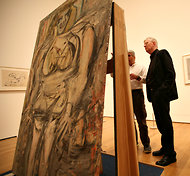
Elderfield preparing for the exhibition
Read more from Art News Here:
http://www.artnews.com/2011/09/08/shaping-de-koonings-legacy/
Week #2 Summer Scenester Scavenger Hunt Answer Key
Here are the answers to week #2 of the Summer Scenester Scavenger Hunt. Be honest, how many did you guess?
Week #3 will be posted next Monday.


Week #3 will be posted next Monday.
Bathroom, Tap Room
Carpet, Liberty Hall
Cigarette Machine, Harbor
Bathroom, Bottleneck
Sign at the Replay
Patio of the Replay
Amyx (where Joe works)

Joe
Wednesday, July 4, 2012
4th of July Flags

Photo by Earl Iversen
detail of Hans and Matelda Wegner Grotto. Near Cataract, Wisconsin., 1994


"Flags 1" Jasper Johns, Screen Print, 1973

Photo: Robert Frank from his book "The Americans"
Subscribe to:
Posts (Atom)